There’s a specific kind of hope that only football supporters understand. It’s the feeling you get watching your team punch above its weight for 90 minutes, even when you know the odds are stacked. For England fans, that feeling has been a recurring theme for decades.
England and Argentina have a history that’s less a rivalry and more a grudge match passed down through generations. The 1966 World Cup quarterfinal with Antonio Rattin’s red card. Diego Maradona’s Hand of God in 1986. David Beckham’s red card in 1998 and the taunting from the Argentine bench afterward. The 2002 rematch where Trevor Sinclair accidentally wandered onto the wrong bus and got a reception that would’ve made a diplomat nervous. This is not a friendly rivalry. It’s personal.
So when the two sides met in November 2005 for a friendly in neutral Geneva, neither team was treating it like a casual scrimmage. Both had already qualified for the 2006 World Cup. Both were considered contenders. But England’s so-called Golden Generation was being openly questioned after a shaky qualifying campaign capped by a loss to Northern Ireland. Sven Goran-Eriksson, once untouchable, was suddenly getting side-eye from the press.
Argentina came out looking like the team that had read its own press clippings. Juan Roman Riquelme was pulling strings. Hernan Crespo put one in the net only to have it waved off. Then Crespo scored for real off a Maxi Rodriguez pull-back around the half-hour mark, and it felt like the natural order of things. Argentina’s spine was world-class: Roberto Ayala, Riquelme, Crespo, Carlos Tevez, Javier Zanetti. England’s fullbacks that night included Luke Young, Wayne Bridge, and Paul Konchesky. Not exactly even on paper.
But England didn’t fold. Six minutes before halftime, Frank Lampard’s pass bounced off Ayala, Beckham headed it down, and a 20-year-old Wayne Rooney tucked it home. Rooney was still in that early phase of his England career where everything felt possible. He played like a kid who’d mainlined Haribo and Monster Energy, chipping the keeper with a shot that almost dislocated Roberto Abbondanzieri’s shoulder.
Argentina steadied themselves. Kevin McCarra’s match report in The Guardian called their display an “extravaganza of sophistication.” Walter Samuel nodded in a Riquelme delivery to restore the lead, and England looked disjointed. Ledley King was stranded in the holding role. The midfield wasn’t tracking back. It felt like a slow bleed.
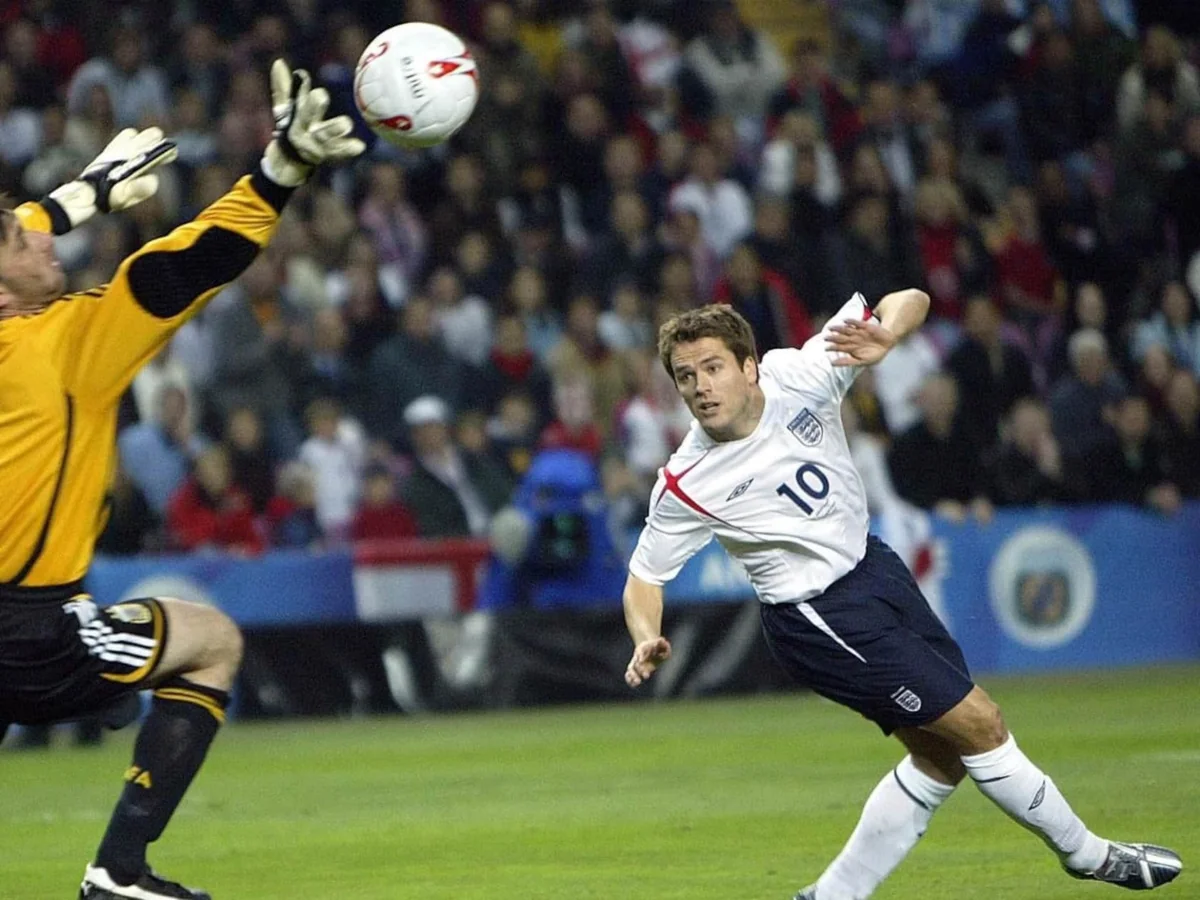
Then came the final 25 minutes. England, playing in some sort of trance, started hammering Argentina without creating many clean chances. The real drama hit in the 88th minute. Steven Gerrard, who’d been shoved around three different positions all game, swung in a cross that Michael Owen met with a downward header. Tie game.
There was still time for Beckham to head one straight at the keeper and for Gerrard to hack down Julio Cruz in what should’ve been a penalty. Argentina never got the call. England went straight back upfield. Joe Cole floated a cross from the left. Owen, using what can only be described as a PhD in spatial awareness, out-jumped his own teammate Peter Crouch and powered home another header. Argentina’s nightmare returned.
That brace was Owen’s last great performance for England. His career has since been remembered for injuries and awkward commentary. But on that night in Geneva, he was the scourge of Argentina all over again. Sammy Lee sprinted down the touchline celebrating like a man who’d just won the lottery.
The result gave England fans real hope for the 2006 World Cup. We all know how that ended. But for one night in November, it was enough just to have the feeling.
Leave a Comment