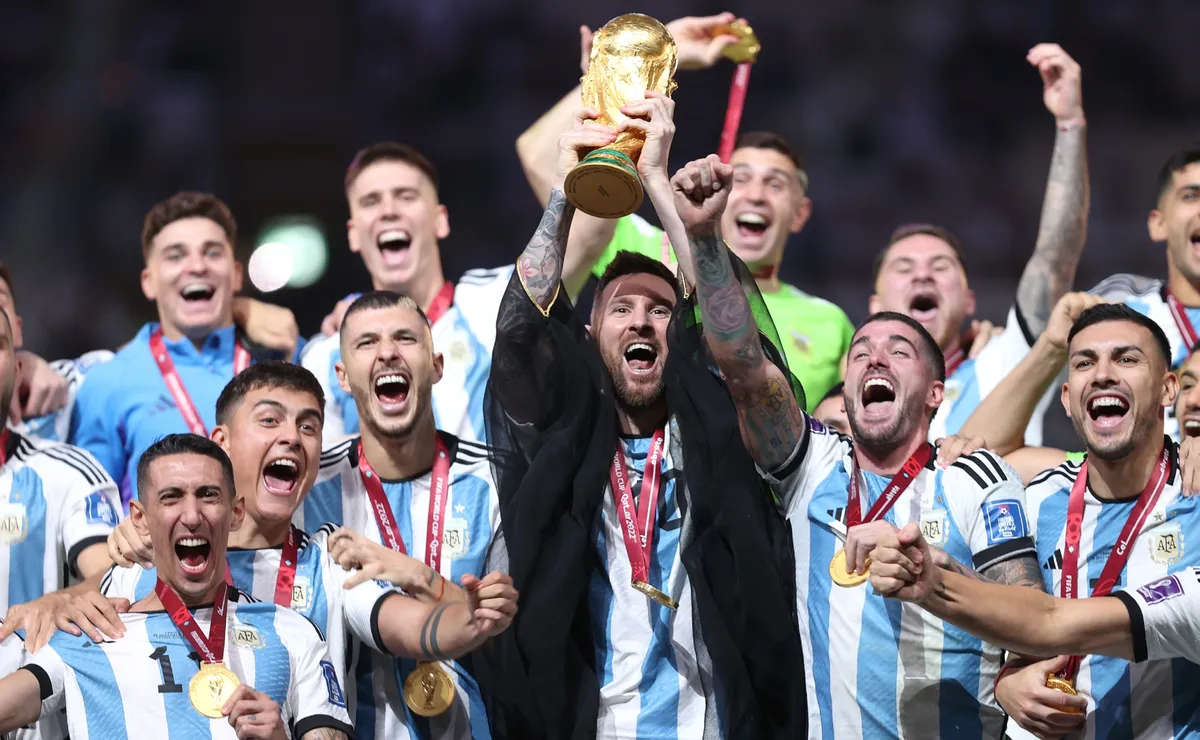
Lionel Messi is heading into his sixth World Cup, and for the first time in his legendary career, he’s not just chasing glory — he’s defending it. But a bombshell stat uncovered by Telemundo journalist Jaime Macias has fans and insiders buzzing with both excitement and dread: Argentina has brought back more outfield players from their 2022 title run than any other defending champion this century, and according to the historical record, that could be a ticking time bomb.
Of the 26 players Lionel Scaloni named for the 2026 tournament in Mexico, Canada, and the United States, 15 are returning outfield players who lifted the trophy in Qatar. That’s the highest retention rate for any World Cup-winning squad since the year 2000. With only 11 fresh faces on the roster, some insiders are reportedly worried that the reigning champs might be leaning too heavily on the past — and history suggests they should be terrified.
Let’s run the cursed numbers. Spain brought back 14 outfield survivors from their 2010 triumph into 2014 and suffered an embarrassing group-stage exit. France returned 13 from their 1998 squad heading into 2002 and earned exactly one point before crashing out. Italy took eight from their 2006 title team to 2010 and went home early. Germany did the same with eight returnees from 2014 in 2018 — first-round flameout. Even Brazil, who carried eight from 2002 to 2006, escaped the group but fell in the quarterfinals despite a roster stacked with Ronaldinho, Ronaldo, and Adriano.
“The more champions you bring back, the worse you seem to do — that’s the pattern,” one former international scout told us. “It looks like loyalty, but it might actually be complacency creeping in.”
What makes Argentina’s case different — and potentially more dangerous — is the expanded 48-team format for 2026. The defending champs now have a safety net that earlier sides didn’t: a second life for the eight best third-place finishers makes a complete group-stage meltdown far less likely. Some observers argue that alone could spare Scaloni’s squad from the curse. Others say that only masks the deeper issue.
Argentina arrives as back-to-back Copa América champions, winners of the 2022 Finalissima, and fresh off a CONMEBOL qualifying campaign that produced 38 points — their second-best total ever, behind only the 43 they racked up ahead of 2002. But the squad’s average age is 29.1, making it the oldest among major contenders alongside Brazil. France averages 27, Spain 26.8, Portugal 28. “Experience is a double-edged sword,” one analyst noted. “You want leaders, but you also need legs — and that’s where the questions start.”
The 2022 World Cup-winning outfield players returning for 2026 include Nicolas Tagliafico, Gonzalo Montiel, Lisandro Martinez, Cristian Romero, Nicolas Otamendi, Nahuel Molina, Leandro Paredes, Rodrigo De Paul, Exequiel Palacios, Alexis Mac Allister, Enzo Fernandez, Julian Alvarez, Lautaro Martinez, and Thiago Almada — plus, of course, the GOAT himself, Messi. But one glaring absence from the starting XI that beat France in the final is Angel Di Maria, whose creative spark has not been directly replicated. Scaloni reportedly tried Thiago Almada and Giovani Lo Celso in that role, or else turned to Nicolas Gonzalez and Giuliano Simeone for more grit on the flanks.
The eight newcomers with no World Cup experience are Leonardo Balerdi, Facundo Medina, Valentin Barco, Giuliano Simeone, Nico Paz, Jose Manuel Lopez, Nicolas Gonzalez, and Lo Celso — the latter two having been part of Scaloni’s plans before injuries derailed their 2022 hopes. Paz, Barco, Balerdi, and Simeone represent the next wave pushing for minutes, but sources close to the team claim there’s a quiet tension between the old guard and the new blood. “The 2022 guys have a bond that’s impossible to replicate,” one insider told us. “But that same bond can become a bubble — and bubbles pop.”
Perhaps the most chilling variable is psychological. The 2022 group played with the desperate energy of a team chasing Messi’s last realistic shot at greatness. That shared mission carried them through a shocking opening loss to Saudi Arabia and every knockout round. With the mission accomplished, the question that insiders are reportedly asking is whether that same hunger can survive success. “It’s human nature,” a former Argentina team staffer said. “Once you’ve climbed the mountain, it’s hard to act like you’re still at the bottom. Scaloni has to reignite a fire that already burned out — and that’s harder than lighting it the first time.”
So far, Copa America wins and a commanding qualifying run suggest the answer might be yes. But the World Cup is a different beast. And if history is any guide, Argentina’s loyalty to its champions could be the very thing that brings them down.
Leave a Comment