
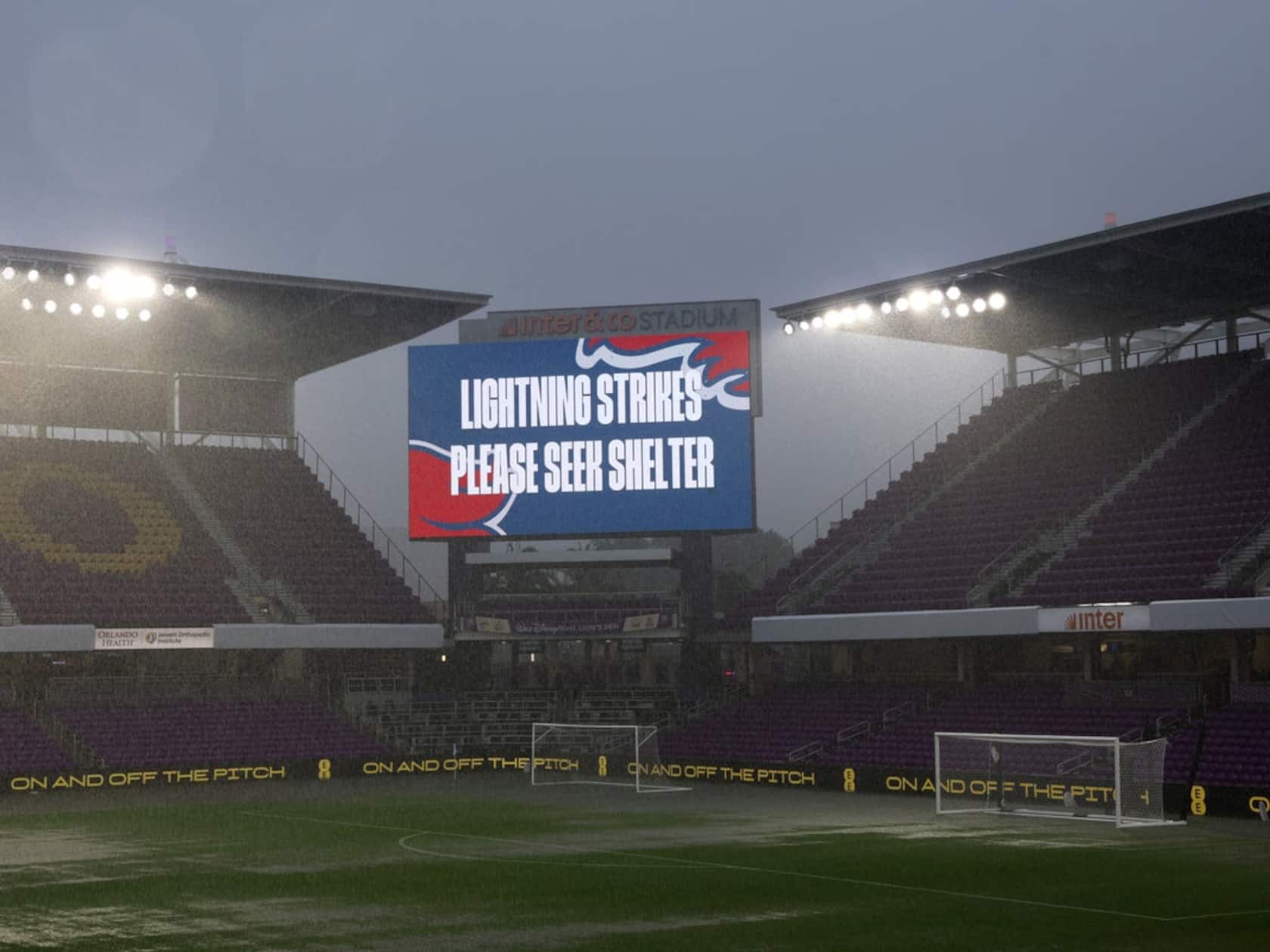
Six matches at last year’s Club World Cup in the United States were stopped because of lightning. One game between Chelsea and Benfica in Charlotte kicked off at 4:38 p.m. local time and didn’t end until nearly four and a half hours later. That kind of delay isn’t just an inconvenience — it’s a preview of what could happen on the biggest stage in soccer at the 2026 World Cup.
The tournament, co-hosted by the United States, Canada, and Mexico, lands squarely in peak thunderstorm season for large portions of the host countries. And FIFA is bound by local weather protocols, particularly strict lightning rules enforced by the National Oceanic and Atmospheric Administration (NOAA). According to those rules, if a lightning strike is detected within eight miles of a stadium, play must stop immediately.
That’s not a soft guideline — it’s a hard stop. A 30-minute countdown begins once the last strike is detected within that eight-mile radius, and any subsequent strike resets the clock entirely. In the worst case, a series of storms moving through an area could stretch a stoppage into multiple hours, as happened during that Chelsea-Benfica matchup.
Storm Season Meets Synchronized Kickoffs
The Gulf Coast and southeastern United States are the likeliest trouble spots. Florida, Texas, and parts of the Carolinas and Georgia see frequent afternoon and evening thunderstorms in June and July, exactly when the World Cup group stage will be played. Even if a storm doesn’t dump heavy rain, a single lightning strike within range is enough to trigger a delay.
England already got a taste of that during a pre-tournament friendly against Costa Rica in Orlando. Heavy rain and lightning threats pushed the kickoff back by an hour. Meanwhile, New York City saw temperatures in the mid-30s Celsius during the tournament’s opening days, followed by severe thunderstorms less than 24 hours before Brazil faced Morocco in New Jersey.
The most complicated scenario could arise during the final round of group-stage matches. FIFA synchronizes the two kickoff times in each group to prevent any team from gaining an advantage by knowing the other result. If a weather delay hits one of those games, the synchronized schedule collapses — forcing either an uneven restart or a situation where one team plays with full knowledge of what it needs to advance. World Cup regulations state that if conditions force an outright abandonment, the game will resume on a future date from the exact minute it stopped. But that’s a nuclear option no organizer wants to exercise.
Case-by-Case Chaos
FIFA has said it will handle each weather stoppage on a case-by-case basis, meaning there’s no blanket rule for how long a delay can last before a match is suspended. The protocol leaves room for flexibility, but also for inconsistency. Fans traveling to stadiums in storm-prone regions may want to pack for a long day — a 90-minute match could easily turn into a four-hour affair, or more.
The 2026 World Cup will be the first with 48 teams and 104 matches, spread across three countries. Weather forecasting will be as critical as team tactics, and lightning might end up being the most unpredictable opponent of all.
Leave a Comment