
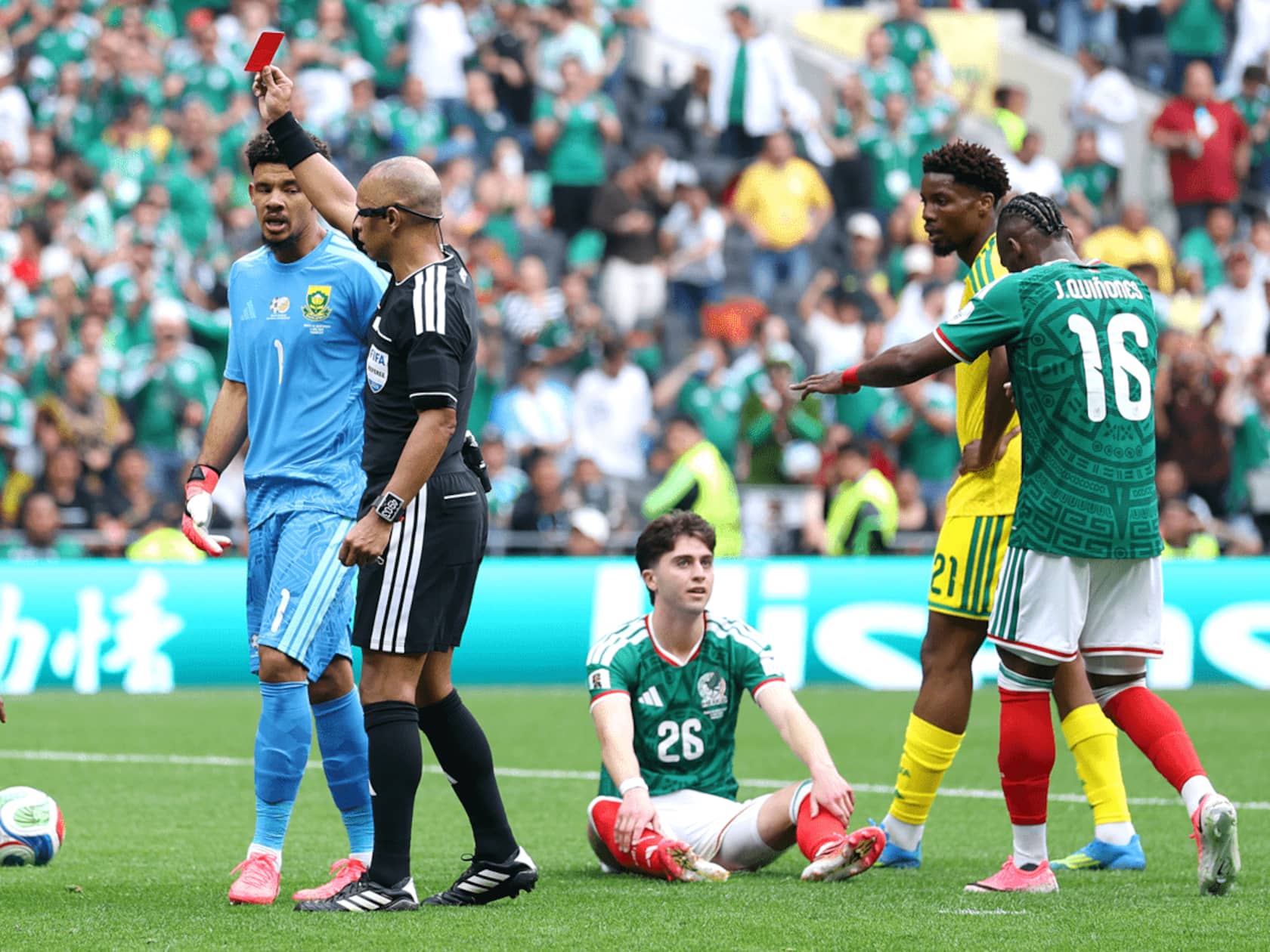
The opening match of the 2026 World Cup was supposed to be a celebration — a homecoming for Mexico, a showcase for the global game. Instead, it descended into chaos, and insiders are already buzzing that this could be a sign of something far more dangerous for the tournament.
By the time the final whistle blew at Estadio Azteca, referee Wilton Pereira Sampaio had brandished three red cards — a tally that, according to reports, matches the combined straight red cards from the entire 2018 and 2022 tournaments. Sources close to FIFA are reportedly worried that the expanded 48-team format is creating a powder keg of tension, and this match might have lit the fuse.
The Night South Africa’s World Cup Dreams Collapsed
For Yaya Sithole, this was supposed to be a career-defining moment. The Tondela midfielder had waited four years for his World Cup debut. It lasted 49 minutes. He was sent off for hauling down Brian Gutiérrez as the Mexican sprinted toward goal — a decision that, according to former referees who spoke with us, was textbook but still devastating.
Worse still? Sithole had already gifted Mexico their opening goal, losing possession on the edge of his own box after a disastrous pass from goalkeeper Ronwen Williams. Julián Quiñones pounced, and the rout was on. One insider described it as “a nightmare you can’t wake up from.”
But the chaos didn’t stop there. Substitute Themba Zwane was shown a straight red just 23 minutes after coming on — a violent conduct call upheld by VAR. And then, in stoppage time, César Montes was controversially deemed the last man on a challenge that many observers claim was soft at best. Suddenly, three red cards were flashing on the scoreboard.
This Changes Everything for the Tournament
Here’s the stat that has league officials reportedly sweating: after one game, we’ve already seen as many straight reds (2) as the entire 2018 and 2022 tournaments combined (3). If that pace holds, we’re looking at a World Cup where discipline goes out the window — and where matches could devolve into chaos.
“The expanded group stage was always going to create mismatches,” one veteran scout told us. “But nobody expected the floodgates to open this quickly. Teams are going to get frustrated. Red cards could become the norm, not the exception.”
South Africa’s struggles weren’t just about the cards. They managed a paltry 0.07 xG from three shots. They barely laid a glove on Mexico. And with the biggest Power Rankings gap in Group A already exposed, insiders claim that other groups with even wider disparities — and there are several — could produce even uglier spectacles.
Gilberto Mora: The 17-Year-Old Who Could Steal the Show
While South Africa unraveled, a different story was brewing on the Mexican sideline. Gilberto Mora — just 17 years old, five days older than Pelé was when he debuted at the 1958 World Cup — entered the game as a substitute. He becomes Mexico’s youngest-ever World Cup player, and according to sources close to the team, he’s been turning heads in training for months.
Mora burst onto the scene at last year’s CONCACAF Gold Cup, starting three knockout matches as a 16-year-old and creating more open-play chances than any other Mexican player. “He doesn’t look like a kid out there,” one team insider said. “He looks like he belongs. Don’t be surprised if he plays a major role in this tournament.”
With Mexico riding high after a dominant win, Mora could be the X-factor that pushes them deep into the knockout rounds. Fans are buzzing about his potential — and about what he could mean for a side that suddenly looks like a legitimate contender.
The Drip-Drip of Time: A Laissez-Faire Start Raises Eyebrows
And then there’s the clock. The match was scheduled to kick off at 1:00 p.m. local time. It actually started at 1:05:56 — a delay that some observers blame on the opening ceremony and a lengthy pitch-clearing process after the national anthems. But the bigger issue? The game didn’t end until 3:03 p.m., thanks to two hydration breaks in relatively mild 75-degree weather.
That’s two hours and three minutes for a match that should take 105. With 104 games on the schedule, insiders are reportedly concerned that the tournament could drag into the early hours of the morning — especially in venues with less forgiving climates.
“The World Cup is supposed to be a showcase of the best football on earth,” one analyst told us. “If this is how it’s going to play out — three red cards, long delays, and one-sided matches — we might be looking at a very different kind of spectacle. And not necessarily a good one.”
One thing is clear: the 2026 World Cup has already delivered a message. Whether that message is a warning or a promise, only time will tell. But after one game, the football world is watching — and holding its breath.
Leave a Comment