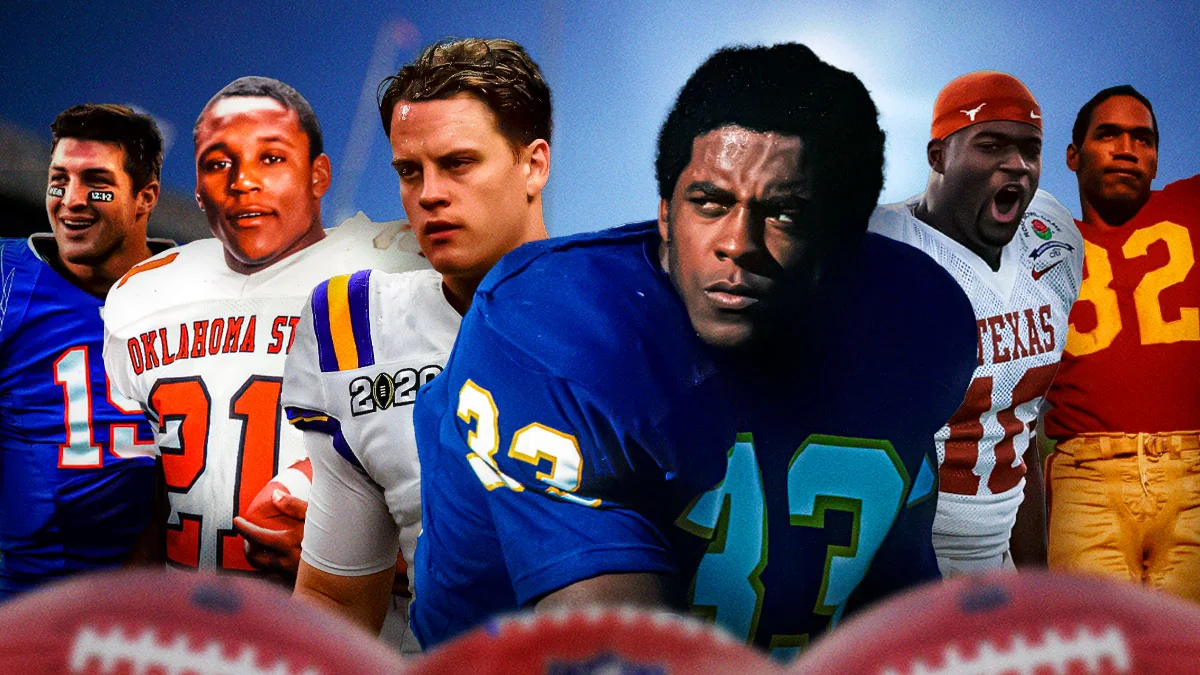
College football looks almost nothing like it did five years ago. The transfer portal. NIL deals. A 12-team playoff. Conferences shifting like sand. And through all that chaos, the game itself hasn’t changed. The best players still dominate. They still make you stop and watch. So we went back and rebuilt the list of the 50 greatest college football players of all time. There’s no adjusting for era here. We don’t care if you played in 1910 or 2024. What matters is how thoroughly you wrecked the competition in front of you. That means a few guys from FCS programs made the cut. One played for a school that doesn’t even exist anymore. Here’s the updated rundown.
1. Herschel Walker. Georgia. Before the NFL trade that reshaped the league and before the USFL, Herschel Walker spent three seasons in Athens doing things that shouldn’t have been possible. He hit at least 1,600 yards and 15 touchdowns every single year. His Heisman season in 1982 gets the headlines, but his 1981 sophomore year was actually bigger: 385 carries, 1,891 yards, 18 rushing touchdowns. He didn’t win the Heisman that year — finished second to Marcus Allen — because voters were apparently nervous about giving it to a sophomore. That didn’t happen again until Tim Tebow in 2007.
2. Archie Griffin. Ohio State. The only two-time Heisman winner in history. He rushed for at least 1,400 yards in three straight seasons as the feature back in Columbus. His 1974: 256 carries, 1,695 yards, 12 touchdowns. His 1975: 262 carries, 1,450 yards, 4 touchdowns. Those numbers might not win a Heisman today. But Griffin was the best player in the country both years, and that’s really all the award is supposed to measure.
3. Tim Tebow. Florida. Some people still argue he’s the greatest college quarterback ever. Two national championships. A Heisman. And that 2007 season — 66.9% completion, 3,286 passing yards, 32 touchdowns, 6 interceptions, plus 895 rushing yards and 23 more scores on the ground. He was the first guy to really play the modern style of quarterback in college football. He led a team loaded with talent but also plenty of distractions. Without his leadership, that Florida team doesn’t become one of the best of the century.
4. Marcus Allen. USC. Allen took a couple years to get going. Once he did, it was absurd. His junior year was great: 1,794 all-purpose yards and 15 touchdowns. Then came 1981. You need to see the numbers to believe them. 433 carries. 2,427 rushing yards. 22 rushing touchdowns. Plus 256 receiving yards and another receiving score. That’s not a typo. He averaged 5.6 yards per carry on 433 runs. Read that again.
5. Bo Jackson. Auburn. Ask anyone of a certain age and they’ll tell you Bo was the greatest athlete they ever saw before his hip injury. They might be right. He won the Heisman in 1985. He rushed for 4,303 yards and 43 touchdowns in his career. Then he went and matched Frank Thomas in baseball. Bo Jackson exists in his own category, even compared to other Auburn legends like Cam Newton and Pat Sullivan. Bo knows this list now.
6. Earl Campbell. Texas. Campbell’s pro career with the Oilers was so great it almost overshadows what he did in college. Almost. He had 928 yards as a freshman, 1,118 as a sophomore. Injuries limited him to seven games in 1976. Then came his senior year: 267 carries, 1,744 yards, 18 touchdowns, all in just 11 games.
7. Tony Dorsett. Pitt. Dorsett hit at least 1,000 yards and 10 touchdowns every season at Pitt. He won the Heisman in 1976 with 370 carries, 2,150 yards, and 22 touchdowns. Most people think he’s better than Dan Marino. That tells you everything.
8. Barry Sanders. Oklahoma State. The single greatest season any running back has ever had. 344 carries. 2,628 yards. 7.6 yards per carry. 37 touchdowns. That’s not a video game. Only Melvin Gordon has come close since. Nobody has touched that single-season record. Sanders scored four more rushing touchdowns than the second-place guy all time.
9. Tommie Frazier. Nebraska. The best quarterback of the 1990s. He ran the triple option, which hurt his stats and probably cost him a Heisman. He finished second in 1995 after a national championship run. That year: 1,362 passing yards, 17 touchdowns, 4 interceptions, plus 604 rushing yards and 14 touchdowns on the ground. If you watched him, you know. His performance in the 1996 Fiesta Bowl against Florida is still the standard for quarterback play in a title game.
10. Ernie Davis. Syracuse. Think about this. You’re asked to replace Jim Brown at Syracuse. Not just any Jim Brown. The greatest football player of all time, according to a lot of people. Davis won the Heisman in 1961. He led Syracuse to a national championship. Then he went to the NFL and did it again. His 1961: 150 carries, 823 yards, 12 touchdowns on the ground plus 157 receiving yards and 2 receiving touchdowns. All in 10 games.
11. Eric Dickerson. SMU. The Southwest Conference in the 1980s was the Wild West. SMU’s recruiting got them the death penalty. But Dickerson was unstoppable. His senior year: 232 carries, 1,617 yards, 17 touchdowns. He had that rare combination of size and speed where he could run through you or just run past you.
12. Jerry Rice. Mississippi Valley State. Rice came from an HBCU that most people had never heard of. He still finished ninth in Heisman voting in 1984. That season: 103 catches, 1,682 yards, 27 touchdowns. The touchdown mark is still the FCS single-season record. His 24 catches in a single game is also an FCS record. The numbers have stood for 40 years.
13. Ndamukong Suh. Nebraska. The most dominant defensive lineman of the modern era. His 2009 season: 85 tackles, 20.5 for loss, 12 sacks. But the stats don’t capture it. He got triple-teamed and still found the quarterback. He should have won the Heisman. He didn’t. That’s a shame.
14. Jim Brown. Syracuse. The greatest player to ever pick up a football. His college numbers don’t jump off the page like his pro numbers do, but he was still a Consensus All-American in 1956 on a national championship team. He had 1,042 scrimmage yards and 14 touchdowns. He also led the nation in kickoff return average in 1955 and rushing touchdowns in 1956. He once scored 43 points in a single game between touchdowns and field goals.
15. Roger Staubach. Navy. Before he was Roger Staubach, Cowboys legend, he was a Heisman winner at Navy. His 1963 season: 1,702 passing yards, 7 passing touchdowns, 7 interceptions, plus 371 rushing yards and 9 rushing touchdowns. Those numbers don’t look huge now, but in 1963 in a triple option, they were incredible. He led the nation in completion percentage and finished top five in passing yards. The Cowboys waited four years for him to finish his military service. Worth it.
16. Ricky Williams. Texas. Williams left Texas as the NCAA’s all-time leading rusher. (Ron Dayne passed him a year later.) He set 21 NCAA records, including 72 career rushing touchdowns. He once ran for over 300 yards in back-to-back games. His Heisman season: 2,386 scrimmage yards, 28 touchdowns, 5.9 yards per carry. He also broke 46 Texas records and 24 Big 12 records.
17. Doak Walker. SMU. Walker was a do-it-all player. He won the Heisman in 1948. He played halfback, defense, kicker, punter, and returned kicks. His 1948 season: 598 rushing yards, 9 rushing touchdowns, 284 receiving yards, 3 receiving touchdowns, 383 passing yards, 5 passing touchdowns, plus he played defense and averaged 42.1 yards per punt. He scored 88 total points. The award for the best running back in the country is named after him.
18. Charles Woodson. Michigan. The only primary defensive player to win the Heisman. He won it over Peyton Manning and Ryan Leaf in 1997. He had 18 career interceptions. He was also one of the best return men in the country and even played offense — 246 scrimmage yards and three touchdowns in 1997. He led Michigan to its first national title since 1948. He also won the Walter Camp Award, the Chuck Bednarik Award, the Jim Thorpe Award, and the Bronko Nagurski Trophy.
19. Ron Dayne. Wisconsin. The all-time NCAA rushing leader with 7,125 yards. He cleared 2,000 yards twice. He had 11 career games with over 200 yards. He’s the only Big Ten player with consecutive Rose Bowl MVPs. At 245 pounds, he was a monster. Defenses just couldn’t bring him down.
20. Red Grange. Illinois. The Galloping Ghost. He put the NFL on the map when he turned pro. In just 20 college games, he had 3,362 rushing yards, 253 receiving yards, 575 passing yards, and 31 total touchdowns. If you average his rushing total to a modern 13-game season, he would’ve had 2,185 yards. That’s tied for eighth all-time in a single season.
21. Glenn Davis. Army. World War II was a huge advantage for the service academies. Davis used that time to finish in the top two of Heisman voting for three straight years. He finally won it in 1946. That season: 1,068 scrimmage yards, 13 touchdowns, plus 396 passing yards and four more scores. He and Doc Blanchard formed Mr. Outside and Mr. Inside. Between rushing, receiving, and passing, Davis had 3,945 total yards and 53 touchdowns for his career.
22. Bronko Nagurski. Minnesota. The Nagurski Award is given to the best defensive player in the country. But Nagurski himself excelled on both sides of the ball. He’s the only player ever named an All-American at two different positions: defensive tackle and fullback. Grantland Rice once said he’d take 11 Bronko Nagurskis over 11 of any other player. That’s enough.
23. Dick Butkus. Illinois. The Butkus Award is given to the best linebacker at every level. Butkus finished third in Heisman voting in 1964 after a college career with 374 tackles. He led Illinois to a Rose Bowl win in 1963. Sacks weren’t an official stat back then, so his numbers feel incomplete. But we know what he became in the NFL. That tells the story.
24. Jim Thorpe. Carlisle. Thorpe was the original American athlete. He won Olympic gold in track and field. He played professional football, baseball, basketball, and even won a national championship in ballroom dancing. Under Pop Warner at Carlisle, he put up legendary performances in the early 1910s. The stats aren’t fully available. But his career was legendary. He paved the way for two-way players and multi-sport athletes.
25. O.J. Simpson. USC. Simpson only played two seasons at USC. He was arguably the best player in the country both years. His off-field issues have tainted his legacy, but you can’t ignore what he did on the field. In 1968, he ran for 1,880 yards and 23 touchdowns. He won the Maxwell Award once and the Walter Camp Award twice in just two seasons.
26. Deion Sanders. Florida State. Prime Time was an absolute playmaker. He had 14 career interceptions, four of which he returned for touchdowns. He set Florida State records with 1,429 punt return yards and three scores. In 1988, he led the nation with a 15.2-yard punt return average. He talked a big game and backed it up. Now he’s the most famous college football coach at Colorado.
27. Peyton Manning. Tennessee. Manning never won a Heisman or a national title. But what he did as a passer was historic. He threw for 11,201 yards and 89 touchdowns in his Tennessee career. He rarely threw interceptions. His 39 wins as a starter were an SEC record. He spurned his family’s school, Ole Miss, for Tennessee, and became arguably the most highly touted prospect ever when he declared for the draft.
28. Randy Moss. Marshall. Moss’s college career started rocky off the field. He was supposed to go to Notre Dame, then Florida State, but legal issues and a failed drug test sent him to FCS Marshall. Once he put on the pads, he was unstoppable. He was the best player on a 15-0 Marshall team. When they jumped to FBS, he won the Biletnikoff Award in 1997. In just 28 games, he put up 4,706 all-purpose yards and 55 touchdowns. He just physically dominated people.
29. Vince Young. Texas. Young was the ultimate dual-threat quarterback. He was the first ever to throw for 3,000 yards and rush for 1,000 in a single season. He won his final 20 games at Texas. The Rose Bowl against USC is the game everyone remembers. The fourth-down touchdown run. The national championship. USC had won 34 straight. It didn’t matter.
30. Christian McCaffrey. Stanford. McCaffrey set the single-season all-purpose yards record as a sophomore with 3,864. He set a Rose Bowl record with 368 all-purpose yards. He led the nation in all-purpose yards in both 2015 and 2016. He had eight straight games with over 200 total yards. His second-place Heisman season in 2015: 2,664 scrimmage yards and 13 touchdowns.
31. Doc Blanchard. Army. The power to Glenn Davis’s speed. Mr. Inside. Blanchard won the Heisman first, in 1945. Army never lost a game with him on the team. He was a three-time All-American and finished top five in Heisman voting three times. That thunder-and-lightning combination will never be replicated.
32. Reggie Bush. USC. Bush had one of the best Heisman seasons of the 21st century. He was forced to vacate it because of a scandal involving improper benefits. He got it back recently, which is good, because he was one of the best college players ever. USC won 34 straight games and two national titles during his career. He had 3,169 rushing yards and was one of the first elite pass-catching backs out of the backfield.
33. Hugh Green. Pitt. Defensive players usually need offensive touches to win Heismans. Green never won, but he finished second in 1980, the highest finish ever for an exclusively defensive player. He was unblockable. Sacks weren’t official then, but he reportedly had double-digit sacks all four seasons and 53 in his career.
34. Dave Rimington. Nebraska. The best offensive lineman in college football history. The only two-time Outland Award winner. He played center for dominant Nebraska teams in the late ’70s and early ’80s. He even won the Big Eight Offensive Player of the Year award. That’s unheard of for an interior lineman.
35. Mike Rozier. Nebraska. Rozier benefited from Rimington’s blocking, but he would have thrived anywhere. He won the Heisman in 1983 with 2,148 yards and 29 touchdowns. That season is one of the best Heisman-winning seasons ever. He ran for 4,780 yards and 49 touchdowns in his career. An ankle sprain kept him out of the 1984 Orange Bowl. If he plays, Nebraska probably converts that two-point conversion and wins the national title.
36. Davey O’Brien. TCU. The award for the nation’s best quarterback is named after him. O’Brien was 5-foot-7, 150 pounds. He played in an era where passing wasn’t emphasized. He still threw for 2,628 career yards, which was jaw-dropping for the 1930s. He was the first Heisman-winning quarterback. If he hadn’t started his career behind Sammy Baugh, those numbers would be even bigger.
37. Gale Sayers. Kansas. The Kansas Comet. He was always a threat to break a long run. He had a 283-yard game against Oklahoma State. He had a 99-yard run. He was the first FBS player to ever do that. He finished with 2,675 yards and 20 touchdowns on the ground.
38. Darren McFadden. Arkansas. McFadden was the Heisman runner-up twice. He led the nation in rushing both seasons. He’s one of only three two-time Doak Walker Award winners. Everyone knows how great he was, even without the Heisman hardware.
39. Steve McNair. Alcorn State. A dual-threat quarterback before it was cool. His name still stands above most FCS statistics. He threw for 5,799 yards in 1994, which was a record at the time. He was in the Heisman conversation despite playing at an FCS school.
40. Brian Bosworth. Oklahoma. The mullet. The huge shoulder pads. The trash talk. Bosworth was one of the most famous college players ever. He led the Sooners in tackles three times. He won the Butkus Award twice. He led Oklahoma to a national championship. He walked the walk.
41. Doug Flutie. Boston College. Flutie was small but had the biggest heart. His Hail Mary against Miami is one of the most memorable plays in college football history. He also put up big numbers: 10,579 yards and 67 touchdowns through the air. He led Boston College to heights they’d never seen before.
42. LaDainian Tomlinson. TCU. Tomlinson left TCU ranked sixth in NCAA career rushing yards with 5,263. His NFL career was so good it made people forget how dominant he was at TCU. His senior season was exceptionally consistent: he didn’t have a single game with fewer than 100 yards, and he scored in every game.
43. Larry Fitzgerald. Pitt. Fitzgerald had the surest hands in the country. He averaged 16.6 yards per reception. He scored a touchdown in 18 straight games, an NCAA record. He had 34 total touchdowns in just two years. If he had played longer, he’d be higher on this list.
44. Orlando Pace. Ohio State. The second offensive lineman on this list. Pace played tackle, often considered the most important position in the trenches. He was known for pancaking defenders. He didn’t allow a sack in either of his final two seasons. He was both physically dominant and technically sound.
45. Joe Burrow. LSU. Burrow started at Ohio State and became a legend at LSU. He had the best quarterback season in college football history. 60 touchdown passes. 726 total points for LSU, an NCAA record. A national championship. He was a one-hit wonder in college, but that one season was special enough to earn him a spot.
46. Derrick Thomas. Alabama. The most dominant pass rusher in college football history. His senior season: 44 quarterback hurries, 39 tackles for loss, 27 sacks. For all the elite defensive players who have gone through Alabama, Thomas stands above them all.
47. Dillon Gabriel. Oregon. Gabriel was never the clear-cut best player in the country. He finished third in Heisman voting in 2024. But he played six seasons thanks to the transfer portal and NIL. He ranks second all-time in passing yards (18,722) and first in touchdowns (155). He helped put UCF on the map, then thrived at Oklahoma, then led Oregon to an undefeated regular season. The era he played in makes comparisons unfair. But records are records.
48. John Elway. Stanford. Elway is best known as an NFL legend, but he was great at Stanford too. He threw for 9,349 yards and 77 touchdowns. He did everything he could to win. But that California game — “The Play” — prevented him from ever reaching a bowl game. His pure talent keeps him on this list.
49. Cam Newton. Auburn. Newton started at Florida as a backup to Tim Tebow. He won a national title there, though he didn’t contribute much. He went to Blinn College and won a junior college national title. Then he went to Auburn and won the national championship again. His lone season at Auburn was one of the best ever. He became the second member of the 30-20 club (30 passing touchdowns, 20 rushing touchdowns). The “Camback” against Alabama is one of the greatest Iron Bowl performances ever.
50. Montee Ball. Wisconsin. This was a tough final pick. We gave Ball the edge over Jonathan Taylor, even though Taylor won the Doak Walker Award twice. Why? Because Ball’s 33 rushing touchdowns in 2011 are the second most in a single season ever. That’s enough to earn him the final spot.
Leave a Comment