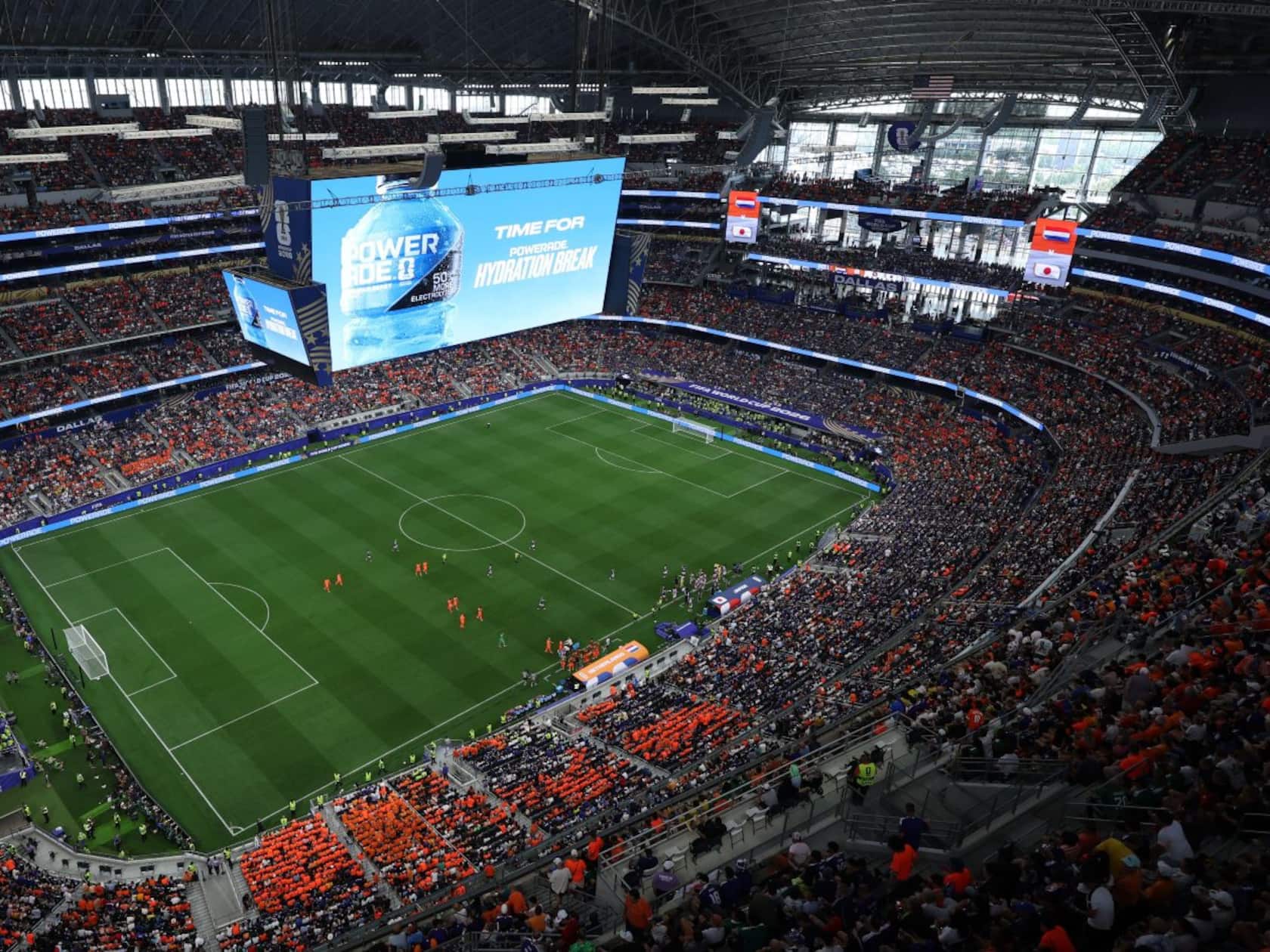
When FIFA announced last December that every game at this World Cup would feature mandatory three-minute hydration breaks, the reaction was muted. The news landed in the middle of a busy Premier League weekend, and the tournament itself still felt like a distant point on the calendar. But now the tournament is here, and the breaks are impossible to ignore.
Virgil van Dijk, captain of the Netherlands, became the first high-profile player to speak out after his team’s 2-2 draw with Japan. “I think hydration breaks are really interesting,” he said, before making his true feelings clear. “Every time going to commercials is a bit… not really something that I like. I think for the neutral watchers on TV it is also not great. So if it is really hot it would be good to put them in, but I think you have to look at it in every game, separately.”
The Dutch defender is far from alone. Irish broadcaster RTE has faced backlash for airing ads during the breaks, with pundit Richie Sadler openly calling it wrong. “I understand there’s a water break, I know that’s a decision taken externally, but ads during a match is wrong. It just is.”
Here’s the problem: these breaks are not a public health measure. They are a commercial opportunity dressed up in sports science. FIFA’s own chief tournament officer, Manolo Zubiria, confirmed in December that the breaks would happen in every game, regardless of temperature or stadium conditions. “No matter where the games are played, no matter if there’s a roof, temperature-wise,” he said. That is a stark departure from the 2022 World Cup, where hydration breaks were only used on a match-by-match basis when extreme heat was a factor.
The shift is subtle but significant. In 2014, the first World Cup hydration breaks were introduced as a common-sense player welfare measure in Brazil’s heat. Nobody complained. Sound familiar? It should. That same pattern played out in club football when Barcelona went from an unsponsored shirt to carrying the UNICEF logo, then the Qatar Foundation, and now Spotify. Each step was defended as noble or at least harmless. Each step opened the door further.
Now the breaks are here, and they are changing the game itself. Soccer was built on continuous flow — momentum swings, sustained pressure, tactical adjustments on the fly. Stopping the clock twice per match gives both managers a de facto timeout. The ebb and flow is broken. And in the United States, where commercial breaks are woven into the fabric of every sport, this feels like a natural fit. For the rest of the world, it smacks of something else: a slow, deliberate creep toward a four-quarter game.
Look ahead. The 2030 World Cup will be in Spain, Portugal, and Morocco — June and July in Seville and Marrakesh. Hydration breaks will be standard. Then comes Saudi Arabia in 2034, likely a winter tournament to avoid Ramadan, but by that point the breaks will have been normalized for a decade. FIFA won’t walk them back. And the sponsors won’t let them.
Van Dijk is right to raise the alarm. Sadler is right to call it wrong. The question is whether anyone is listening — or whether we’ve already accepted the Powerade™ Hydration Break as just another part of the modern game.
Leave a Comment